Free, open-source software that runs your entire business — front office and back office, as one coherent whole. No monthly fees. No feature gates. No catch.
The restaurant owner who checks DoorDash on one tablet, runs payroll on her laptop, takes reservations through Yelp, manages inventory in her head, and does the books in QuickBooks at midnight. That's an operating system. It's just a terrible one.
Every disconnection is a leak. Time leaks. Money leaks. More subscriptions, more fees, more commissions flowing out of the neighborhood. The owner becomes the operating system — and nobody opened a business for that.
"I opened a business to make great food. Not to be the integration layer between seven apps that don't talk to each other."
Ring up sales on one system, reconcile manually somewhere else, and pray the numbers match.
Counted by hand once a week. Out-of-stock surprises at the worst possible moment.
DoorDash, Uber Eats, Instacart — each a separate tablet, separate menu, separate payout.
$89 for POS. $49 for scheduling. $79 for accounting. $39 for loyalty. Every month, forever.
The software costs more than it saves, and still takes three hours every week to reconcile.
The same POS sold to a restaurant, a salon, and an auto shop — three businesses with nothing in common.
Kizo isn't a product competing for market share. It's free, open-source software built because every small business deserves tools as good as what the Fortune 500 has — and shouldn't have to pay a monthly fee to get them.
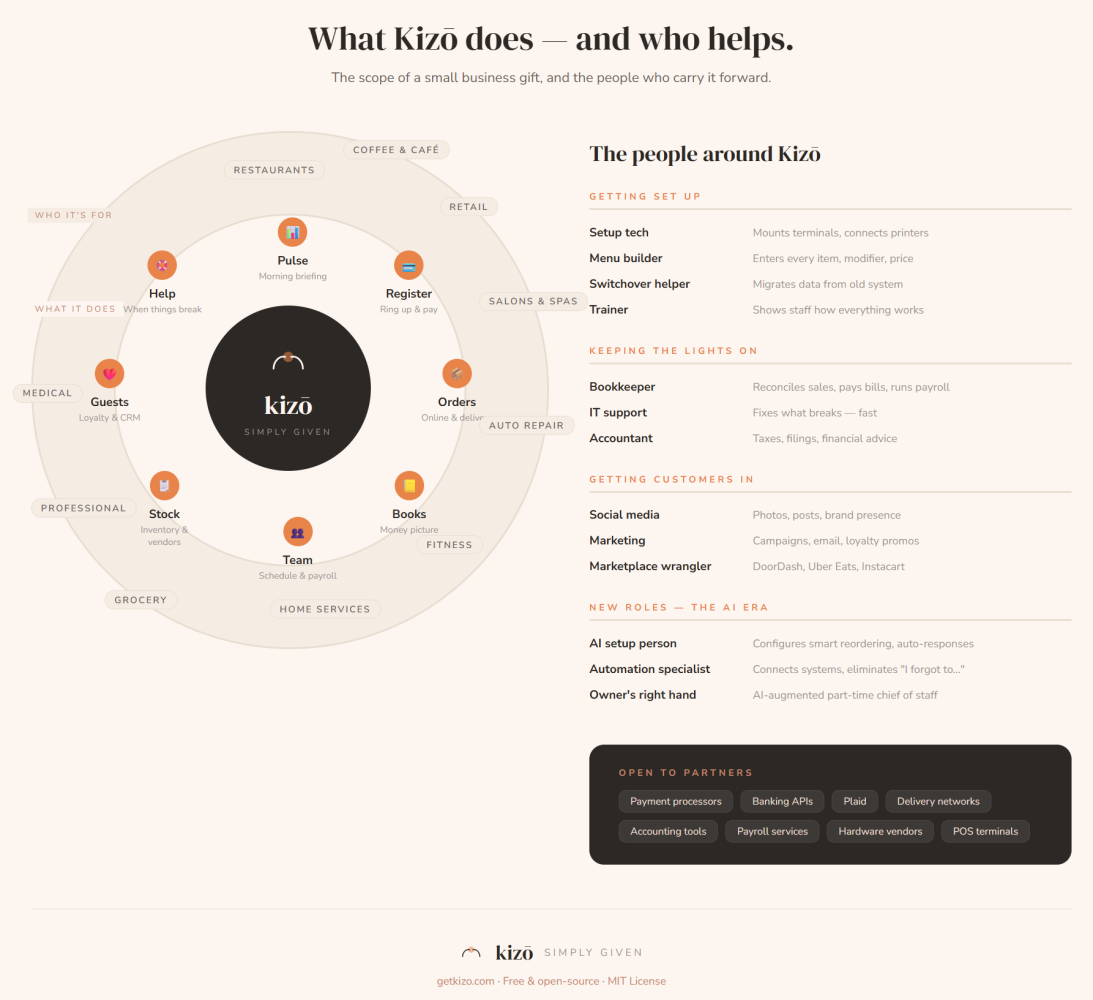
One coherent whole: front office and back office, every module connected. When a customer orders online, that single event ripples through the entire system — inventory, accounting, analytics — automatically.
And around the software: a growing ecosystem of local setup techs, bookkeepers, marketers, and developers who earn real money helping real businesses in their own communities.
Product names avoid jargon. If you have to explain the name, it's the wrong name.
Ring up customers, split checks, handle tips, print or email receipts. The heartbeat of the front office.
Front officeOnline ordering, delivery management, and marketplace sync — DoorDash, Uber Eats, Instacart — all in one place.
Front officeCustomer profiles, loyalty, reviews, and the marketing that brings people back between visits.
Front officeAccounting, reconciliation, and financial reporting. Every sale, every deposit, every marketplace payout — one honest picture.
Back officeInventory tracking, reorder alerts, vendor management, waste monitoring — in real time, not once a week by hand.
Back officeScheduling, time tracking, payroll prep, and labor cost visibility. Without the owner becoming a part-time HR department.
Back officeThe daily briefing. Yesterday's sales, today's schedule, inventory alerts, new reviews, cash position — every morning.
Back officeSupport, troubleshooting, and the person you call when something breaks. Human language, not error codes.
Back officeA ramen order lands on DoorDash. The kitchen display shows it instantly.
Ingredients decrement automatically. Low stock triggers a reorder alert.
The payout lands in Books, net of marketplace commission. No manual entry.
Their profile updates. Kizo Guests knows they love the spicy ramen.
You opened this place because you make great food, cut great hair, or fix anything with an engine. Kizo handles the operating system so you don't have to.
The same AI coding agents that made Kizo possible make it possible for contributors everywhere to adapt it for their language, regulations, and market.
When the software is free and the architecture is open, the opportunity shifts: from subscription revenue flowing out of the neighborhood to service work flowing within it.
Kizo is licensed under a permissive open-source license. The entire codebase — POS, ordering, inventory, accounting, analytics — is available for anyone to inspect, modify, and deploy. There is no community edition vs. enterprise edition. There is no feature gating. There is no phone-home telemetry.
A developer in Corsica can build the module that French restaurants need for fiscal compliance. A contributor in São Paulo can adapt Kizo for Brazilian payment systems. Any payment processor can integrate through adapters — giving ultimate choice to the merchant.
Not freemium. Not free-until-we-raise-prices. Not free-but-we-sell-your-data. Free and open-source, forever. The business model, if there ever is one, will be services — never the software itself.
Your data lives on your hardware. No cloud lock-in. No extraction. No selling your customers to your competitors. You own everything, because it was always yours.
Every contributor who builds a module for their local market makes the project stronger for everyone. Every partner who integrates with an open platform expands what's possible.
AI is in the background. Simplicity is in the foreground. If the owner needs a manual, we failed. Every screen, every notification, every report should be obvious in three seconds.
Whether you run a restaurant, build software, or help businesses thrive —
Kizo is for you. Free, forever.